Showing posts with label Medical Devices.. Show all posts

Thursday, 21 September 2017

Advanced Ophthalmic Lasers for Quick Eye Treatment

Ophthalmic laser treatments are used for numerous non-invasive eye surgeries. These lasers can fix eye problems such as myopia, glaucoma, and cataract among many others. High prevalence of eye diseases contributes to the advancements and demand for different types of lasers.


Pattern Scanning Technology

“Array LaserLink” is an innovative system developed by Lumenis. It provides a new pattern scanning abilities to photocoagulation lasers with a reduced treatment time. This versatile system is designed using multi-wavelength technology. It provides different wavelengths and treatment options. The Array comes with settings such as duration, number of spots, fundus lens selection, spot spacing and size. Additionally, it retains frequently used settings in its memory for user-friendly applications. It uses photopic balanced coating to remove color distortion.

Selective Laser Trabeculoplasty

“Selecta II” by the same company offers premium Selective Laser Trabeculoplasty (SLT) product. Its ergonomically designed laser head is easy to attached and detach. This unit can help medical professionals to simultaneously use the slit lamp as diagnostic equipment and an advanced laser delivery machine. It is compatible with a range of existing commercial converging-optics slit lamps. Additionally, the laser weighs in at nearly 25lbs allowing its easy transportation from one location to the other.

Market Summary

According to a new report by the Grand View Research, Inc.; the worldwide ophthalmic lasers market is projected to attain USD 1.6 billion by 2025. It is anticipated to register a significant CAGR during the forecast period (2014 to 2025). Increasing geriatric population facing eye problems such as cataract and other age related maculated degeneration (AMD) can propel market growth. Vision loss caused by glaucoma, diabetic retinopathy, and cataract can further support the expansion in the near future. 

Market Players

Topcon Corporation, Abbott Medical Optics, Inc., Carl Zeiss Meditec AG, and Ziemer Ophthalmic Systems AG, are some or the key market players. Most companies engage in strategic mergers & acquisitions, regional expansions, and novel product developments to sustain the stern competition.

In-depth research report on ophthalmic laser market:
http://www.grandviewresearch.com/industry-analysis/ophthalmic-lasers-market

Tuesday, 25 July 2017

Innovative Radiation Oncology Methods for Effective Cure

Radiation therapy is one of the most significant cancer treatments. It is often prescribed in combination with chemotherapy and/or surgery for the maximum effectiveness. Radiotherapy focuses on destroying cancer cells and increasing life expectancy of the patients. High prevalence of cancer may boost applications of this therapy. Moreover, technological advancements are anticipated to influence adoption of radiation oncology as the primary treatment of cancer.


Innovative delivery methods of radiotherapy are anticipated to improve effectiveness & safety. Major companies focus on introducing novel radiation technologies. Some of these techniques are already in use, while others need further research & study before they are approved for general usage.

Hyperthermia:-

This treatment utilizes heat for the treatment of different types of cancer. Heat is helpful for removing cancer cells. However, it is not too effective when used without any supplementary therapy. Currently, researchers are studying the heat generated by ultrasound & microwaves to determine its effectiveness with radiation oncology. This can improve the results of the radiation therapy in the near future.

Hyperbaric Oxygen Therapy (HBOT):-

It involves breathing pure & clean oxygen under controlled surroundings. HBOT is carried out in a chamber that is sealed and pressurized at 1½ to 3 times the usual atmospheric pressure. These conditions can improve the sensitivity & response of certain types of cancer to radiation. Research & development for HBOT can put more light on the effects of this therapy in reversing the damage caused to the healthy body tissues during radiation.

Radioprotectors:-

These substances can protect healthy tissues from the harmful effects of radiation. These drugs can protect normal cells from neck and head from exposure to radiation. Amifostine (Ethyol), a common radio protector, is already being used along with radiotherapy.

Market Insights:-

According to Grand View Research, Inc.; the global radiation oncology market is anticipated to grow at a substantial CAGR during the forecast period (2014 to 2025). Rapid technological developments, high healthcare expenditure, and preference for radiotherapy as the primary treatment can propel market growth. Nordion (Canada) Inc.; IsoRay, Inc.; Elekta AB; and Mallinckrodt Public Ltd. Company are some of the chief companies operating in the market.

Thursday, 29 June 2017

Emergence of Natural-Looking Breast Implants

Breast implant is a prosthesis that can change the shape, contour, and size of breasts. In a reconstructive plastic surgery, implant can restore a natural-looking breast mound. They are suitable for post-mastectomy breast reconstruction and corrective surgeries that repair innate deformities & flawed chest walls. Breast augmentation surgery can cosmetically enlarge or improve appearance of breasts. Latest trend of artificially enhancing the physical appearance can boost the demand for these implants. Following are the advancements in the implant technology.


B-Lite Implants:

This device is said to be 30% lighter than other silicone alternatives. It is designed using the unique microsphere technology that disperses small and hollow beads through clinical-grade silicone. These beads are weightless as compared to silicone. As a result, they can create lightweight implants.

Gummy Bear Implants:

These are also called as shaped cohesive gel implants. They have a textured surface and are designed to stay at one place. These implants have lower capsular contracture rate than several other devices commonly available. They are appropriate for the women who search for a natural-looking and durable breast enhancement.

Ideal Implants:

These saline implants have a chain of internal shells. These shells can reduce bouncing and sloshing of the implants. They are intended to feel & look more natural than other saline implantable products.

Market Insights:

According to Grand View Research, Inc.; the global breast implants market is anticipated to register a substantial growth over the next few years. Significant evolution of breast implantation technology and rising preference for cosmetic surgeries are expected to drive the market.

Sientra, Inc.; Establishment Labs S.A.; Polytech Health & Aesthetics GmbH; Mentor Worldwide LLC; Shanghai Kangning Medical Supplies Ltd.; HANSBIOMED CO. LTD.; & Guangzhou Wanhe Plastic Materials Co., Ltd. are some of the key market participants. Most companies adopt mergers & acquisitions, novel product development, and regional expansions as the chief corporate strategies to sustain the stern competition.

In-Depth research report on breast implant market:
http://www.grandviewresearch.com/industry-analysis/breast-implants-market

Thursday, 15 June 2017

Electroencephalography (EEG) Devices for Early Diagnosis of Brain Disorders

Geriatric populace is highly susceptible to neurological disorders. Electroencephalography systems & devices play a vital role in detecting such disorders. Advancements in these medical equipment can expand their reach to other fields.

What are EEG Devices?

Electroencephalography (EEG) can record electrical impulses emitted by the brain. According to a World Health Organization (WHO) study, more than 50 million people are suffering from epilepsy. EEG devices and systems can be utilized to detect the early signs of epilepsy and other neurological disorders such as brain tumor, Motor Neurone Disease (MND), Alzheimer’s disease, and others.


Communication Using BCI

Brain computer interface (BCI) technology acts as a communicator between the brain and an external device. Recently, scientists have conducted an experiment on a group of paraplegics to test their responses to BCI. These patients of spinal cord injuries were taught to walk with the help of a robotic exoskeleton and their responses were recorded with EEG devices. Another study conducted by BrainScope Company Inc. showed the efficiency of its EEG device, AHEAD 300. It can predict the severity of head injuries with nearly 90% accuracy.

Portable Devices

According to a recent study by a team of scientists from Germany, China, and U.S., a brain-reading machine was able to interpret blinking signals into appropriate brain waves in patients with MND. The success of such trials could culminate in the use of EEG machines for other disorders as well. Corporations are keen on manufacturing portable EEGs to target small scale researchers. NeuroSky Mindwave and Emotiv Epoc are some examples of such handheld devices.

Market Overview

The worldwide electroencephalography (EEG) systems/devices market is projected to attain nearly USD 1.4 billion by 2025, according to Grand View Research, Inc. It is anticipated to expand at around 7.6% CAGR over the forecast period (2014 to 2025). The market is driven by the effectiveness of EEG devices and high prevalence of neurological disorders.

The 32-channel EEG devices are expected to continue dominating the global market over the forecast period due to technological breakthroughs and rising adoption. Portable EEG devices are expected to register a lucrative growth till 2025. In 2015, North America led the global market, followed by Asia Pacific and Europe. Notable market players are Natus Medical, Inc.; Cadwell Laboratories, Inc.; Noraxon U.S.A., Inc.; and Medtronic.

In-Depth research report on electroencephalography (EEG) systems/devices market:

Tuesday, 28 February 2017

Disposable Syringes - A Modern Approach to Disease Prevention

The good old saying, “prevention is better than cure” is apt for diseases. Preventive measures have been taken in the past to contain the spread of various epidemics, but the spate of blood-borne diseases like HIV, hepatitis, Ebola, etc., brought us to mull over an important question—is there a better way? There was and it came to us in the form of “disposable syringes.”


Disposable Syringes - Brief Overview

These syringes are used by doctors and medical assistants for intravenous delivery of medicines. They are also used for extracting blood for routine examinations. Disposable syringes are made of plastic or polypropylene and employed across multiple healthcare facilities. They are very popular due to their sterile nature, low production cost, and ready availability. Moreover, their popularity stems from AIDS-stricken countries. HIV-transmission was also attributed to the reuse of syringes for treatments.

Trendsetters 

Autodisable syringes are disposable syringes that can be used only once. Their plungers lock themselves if attempted to be used again. Credit for this invention goes to Marc Koska, a doctor who endorsed the idea in 1997. This idea was rebuffed due to the high cost of plastic & the resistance of glass syringe manufacturers who could lose market share.

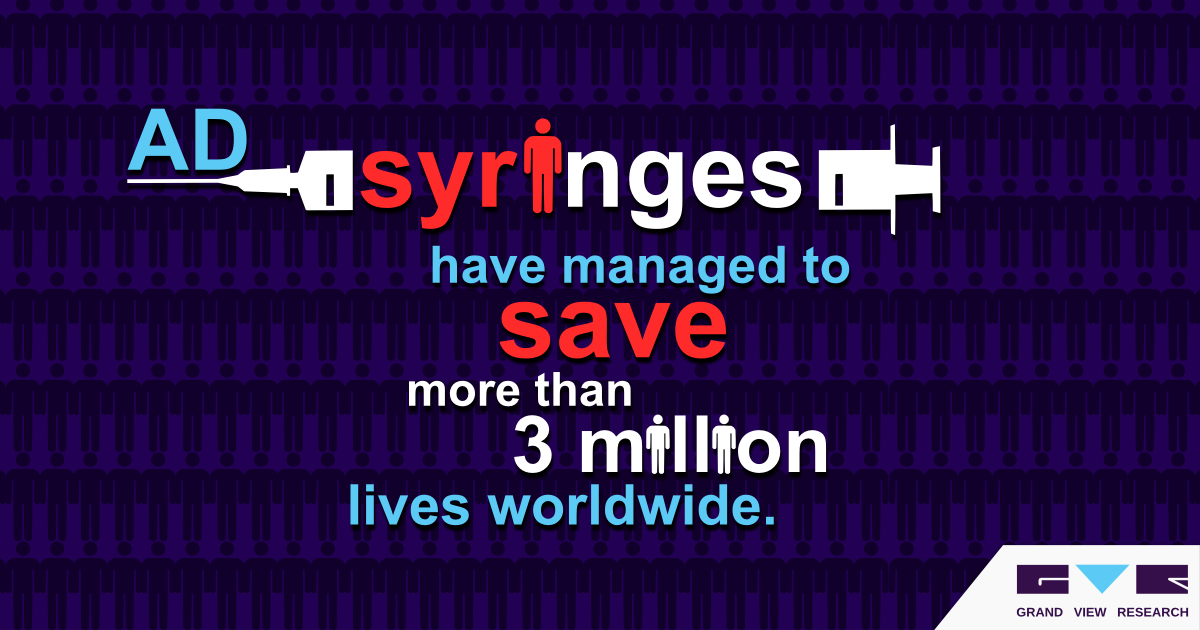
Shared syringes have caused nearly 21 million hepatitis B and 2 million hepatitis C infections. The K-1 syringe, developed by Koska, has been endorsed by SafePoint (a charity created by him) that is involved in creating awareness regarding needle injuries. As on date, these syringes have saved over 3 million lives.

Market Insights 

The global disposable syringes market is expected around USD 9.9 billion by 2024. Rise in the approval of injectable drugs is a key market contributor. Patients and hospital staff afflicted with needlestick injuries generate additional industry demand. The Needlestick Safety and Prevention Act passed in 2000 favored the market and can be accounted for high market growth.

Safety syringes were the biggest segment in 2015. They provide better safety than conventional syringes. North America led the worldwide industry in 2015 due to regional sanctions of injectable drugs. Asia Pacific holds vast potential due to the expanding healthcare sectors of China and India. 
With a total healthcare valuation of USD 400 billion, the Indian subcontinent boasts of huge requirement of medical equipment. Some key players in the global market are Becton, Dickinson & Company; Medtronic plc; Baxter International, Inc.; and Terumo Corporation.

In-depth report on Disposable Syringes Market by Grand View Research:

Rising Mining and Construction Activities Boost Utility Trucks Demand

26 November 2020: Utility vehicles are motorized vehicles that carry out a particular task more effectively than a passenger vehicle. Utili...